


AsterNOS Architecture
Overview
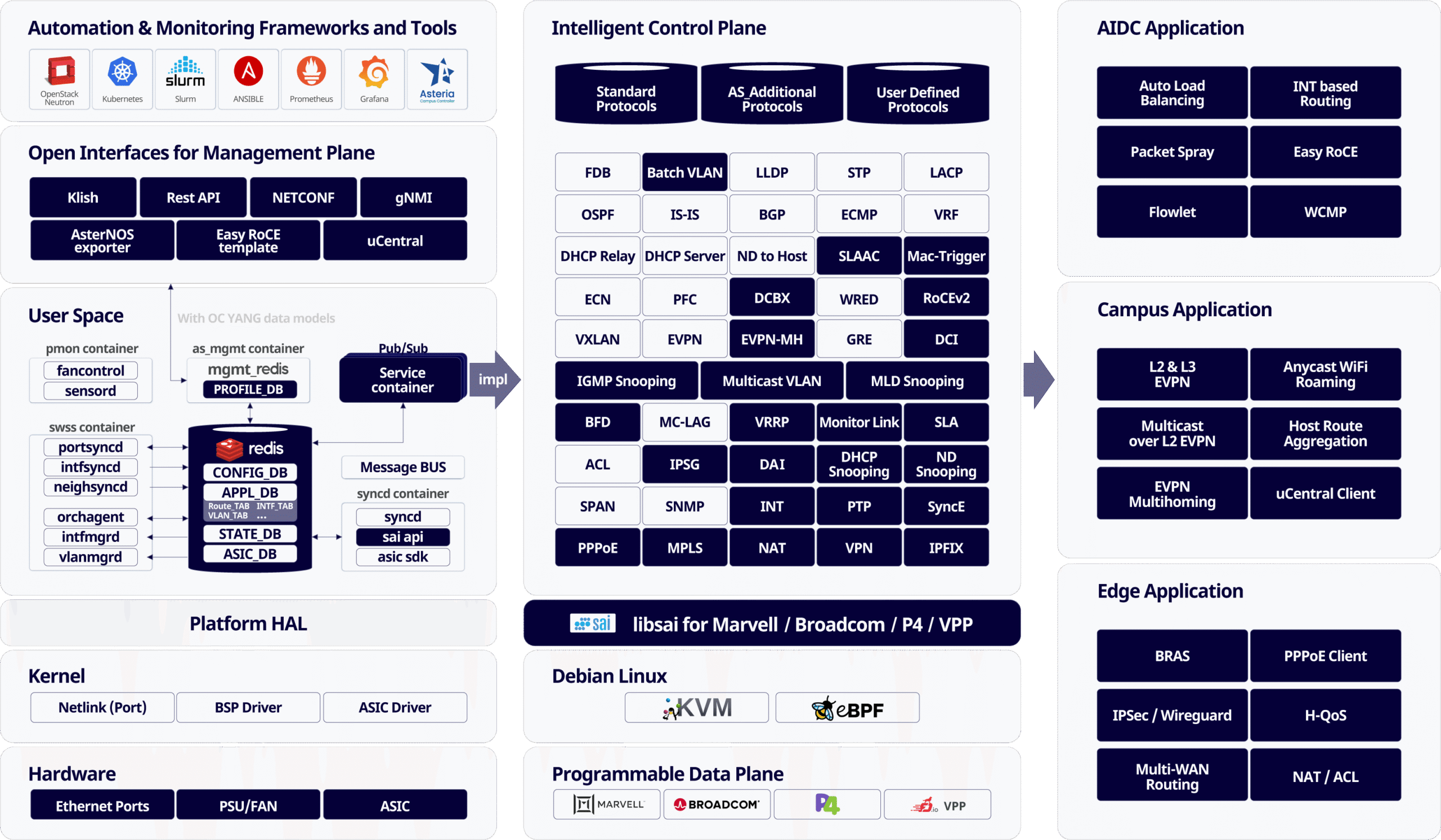
Section titled “Overview”AsterNOS is a production-hardened distribution built on SONiC (Software for Open Networking in the Cloud). It packages the open-source switching stack with Asterfusion integrations, hardware support, and turnkey tooling so you can deploy the same NOS across data center switches, campus access devices, routing gateways, and packet brokers.
At a high level, AsterNOS separates concerns into:
- Data plane — packet forwarding on the ASIC (or VPP/user-space datapath on gateway platforms), programmed through SAI and the switching stack.
- Control plane — routing protocols, EVPN, ACL/QoS policy, and management agents running in isolated services.
- Management plane — CLI, configuration persistence, streaming telemetry, and (where supported) NETCONF/gNMI.
SONiC foundation
Section titled “SONiC foundation”SONiC runs on a Linux host and orchestrates network functions as Docker containers coordinated through a central Redis configuration database. The most important building blocks are:
| Component | Role |
|---|---|
| syncd | Talks to the switch ASIC through SAI; applies forwarding state from the database. |
| swss (orchagent) | Orchestrates L2/L3 objects (routes, neighbors, VLANs, ACLs) into ASIC programming. |
| teamd / BGP / FRR | Control-plane protocols and link aggregation, depending on feature and image. |
| database / config | config_db.json and Redis tables hold the intended configuration; config reload and write manage persistence. |
AsterNOS extends this foundation with product-specific feature containers, hardware abstraction for Asterfusion switch platforms, and a Cisco-like CLI that maps operator commands to the underlying SONiC configuration model.
Deployment roles by product line
Section titled “Deployment roles by product line”The documentation on this site is organized by where AsterNOS runs in your network, not by a single monolithic feature list:
| Product line | Network role | Typical features |
|---|---|---|
| Data Center & AI Fabric | Leaf, spine, AI backend fabric | BGP EVPN VxLAN, MC-LAG, RoCEv2 PFC/ECN, ECMP |
| Enterprise & Campus | Access, aggregation, core | STP/MSTP, 802.1X, PoE, DHCP snooping, QoS |
| Routing & Gateway | Edge, DC gateway, virtual appliance | NAT, IPsec, VPP forwarding, HQoS, nginx/PPPoE |
| Packet Broker | Visibility fabric | Port mirroring, filtering, traffic replication |
| Asteria Controller | Management overlay | Topology design, ZTP, monitoring, lifecycle |
The same SONiC principles apply everywhere—containers, Redis, and structured configuration—but each product line documents the features and CLI surface relevant to that deployment.
Data plane vs. control plane
Section titled “Data plane vs. control plane”Control-plane protocols (BGP, OSPF, LLDP, SNMP, etc.) compute reachability and policy, then publish state into the configuration database. Orchestration agents translate that state into ASIC or datapath programming. This split is why many troubleshooting workflows start with:
- Verify the protocol or feature in Linux (
show bgp,show vlan, etc.). - Confirm the configuration database reflects the intended state.
- Validate forwarding with
show ip route,show mac, or platform-specificshowcommands.
On VPP-based gateway images, a high-performance user-space datapath handles forwarding while management still follows the AsterNOS CLI and configuration patterns documented under Routing & Gateway.
Management interfaces
Section titled “Management interfaces”| Interface | Availability | Notes |
|---|---|---|
| CLI | All product lines | Primary configuration surface; Cisco-like hierarchical views. |
| NETCONF | Enterprise v6 | Structured configuration for campus deployments. |
| SNMP / sFlow / telemetry | Platform-dependent | Documented per product configuration guide. |
| Asteria Controller UI | Controller deployments | Intent-based design, provisioning, and operations. |
Configuration changes made through the CLI are typically runtime until saved with write (persisted to /etc/sonic/config_db.json).
Asteria Controller in the architecture
Section titled “Asteria Controller in the architecture”Asteria Controller is an optional management layer for campus and AIDC fabrics. It does not replace SONiC on switches; it automates design, provisioning, and operations across many AsterNOS devices:
- Campus — spine–aggregation–leaf designs, policy rollout, monitoring.
- AIDC (Beta) — data-center-style automation and visualization for AI fabrics.
Operators still refer to switch-level guides in the relevant product line for protocol and feature details; controller guides explain how to model and deploy those features at scale.
How this documentation site is structured
Section titled “How this documentation site is structured”Top tabs → product line (Data Center, Enterprise, …)Version picker → Enterprise v5/v6, Controller Campus/AIDCLeft sidebar → chapters for the active product/versionSearch → cross-product command and feature lookupNew to AsterNOS? Read this page, then open the product tab that matches your hardware role and start from the Configuration Guide → Preface chapter in the sidebar.
Related topics
Section titled “Related topics”- Get Started with AsterNOS — documentation map and reading paths.
- Data Center & AI Fabric — EVPN, RoCE, and fabric design guides.
- Enterprise & Campus v6 — campus switching and NETCONF.
- Routing & Gateway — edge and virtual gateway scenarios.